Executive Summary
The transition to smart grids in India demands robust communication infrastructure for last-mile connectivity. Our client, a key player in the energy meter manufacturing sector, faced challenges with the cost and complexity of existing AMI solutions. We engineered a custom BLE Mesh network integrated directly into their smart meters. This solution created a resilient, self-healing data collection network, enabling utilities to gather granular energy data efficiently, even in challenging environments.
The Challenge: The Data Gap in the Last Mile
Our client's utility customers needed to move beyond manual, monthly meter readings to a system of real-time, automated data collection. This was essential for accurate billing, loss detection, and load monitoring. However, traditional solutions were inadequate:
High Cost of Cellular Connectivity: Using GSM/GPRS modules in every meter incurred significant recurring data subscription costs, making large-scale deployments economically unviable.
Limited Range of LPWAN: While LPWAN technologies like LoRaWAN offer long range, they often require dense infrastructure of gateways, especially in areas with challenging topography or dense urban layouts, adding to capital expenditure.
Complex Network Topology: Solutions like Zigbee required careful network planning and were often susceptible to single points of failure, leading to data blackouts.
Difficulty in Remote Areas: Providing reliable connectivity in remote or geographically isolated locations remained a significant hurdle.
The client needed a communication technology that was low-cost, reliable, capable of deep penetration in dense environments, and easy to deploy at scale.
The Solution: A Resilient Data Mesh
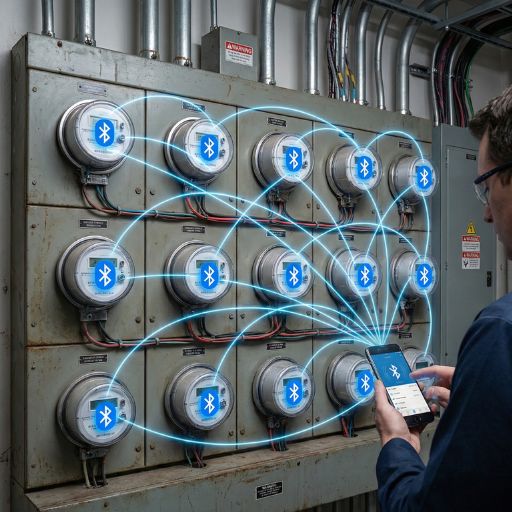
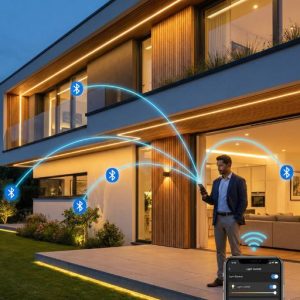
We designed a BLE Mesh networking stack specifically optimized for the low-duty-cycle, high-reliability demands of the energy sector. Each smart meter was transformed into a node in a vast, peer-to-peer communication network.
Key Features of the BLE Mesh for Energy Meters:
Data Concentrator Unit (DCU) Architecture: We designed the system around a strategic BLE Mesh Gateway, acting as a Data Concentrator Unit (DCU). A single DCU, installed on a utility pole or a strategic building, can collect data from hundreds of meters within a ~200-meter radius, leveraging the multi-hop capability of the mesh.
Optimized for Low Power: The firmware was meticulously designed for minimal power consumption. Meters spend most of their time in sleep mode, waking up at scheduled intervals to transmit data, ensuring no impact on the meter's own operational lifespan.
Self-Forming & Self-Healing Network: As new meters are installed, they automatically discover and join the mesh. If a meter fails or a communication path is blocked, the network dynamically re-routes data through the next best available path, ensuring data integrity and high collection reliability.
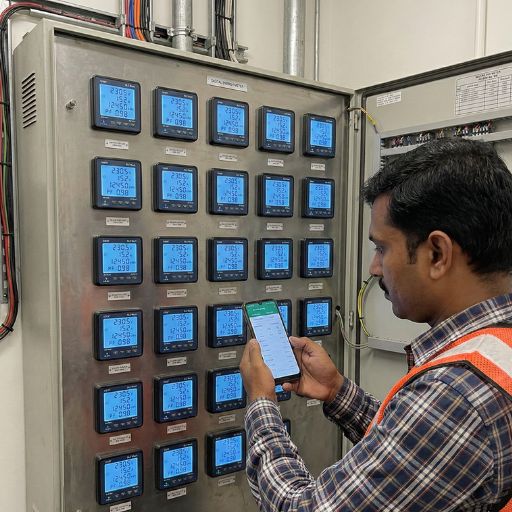
Bidirectional Communication: The solution enables not just data collection (meter reading) but also the ability to send commands to the meter. This allows utilities to perform remote connect/disconnect functions, update firmware Over-The-Air (OTA), and implement time-of-day pricing schemes.
Secure by Design: The BLE Mesh implementation includes robust security features, including AES-128 encryption and device authentication, to prevent unauthorized access and data tampering, a critical requirement for utility applications.
The Result: Transforming Utility Operations
The deployment of the BLE Mesh-based AMI system delivered significant operational and financial benefits.
Drastic Reduction in Operational Costs: By replacing manual meter reading and minimizing cellular subscriptions, utilities have reported a reduction in data collection costs by over 50%.
Near 100% Data Reliability: The self-healing nature of the mesh network ensures that even meters deep inside buildings or basements can relay their data through neighbors, achieving data collection success rates above 99.5%.
Faster Deployment and Scalability: The plug-and-play nature of the network allows for rapid rollout in new housing colonies or industrial clusters, without complex network planning.
Enhanced Grid Analytics: Real-time, granular data from the entire mesh enables utilities to detect energy theft, pinpoint technical losses, and analyze load patterns for better demand forecasting.
Foundation for Future Services: The bidirectional capability creates a platform for future smart grid applications like demand-response programs and dynamic load management.