

Blog
Cybersecurity is a Manufacturing Metric: Protecting Your IP in the Age of Connected Production

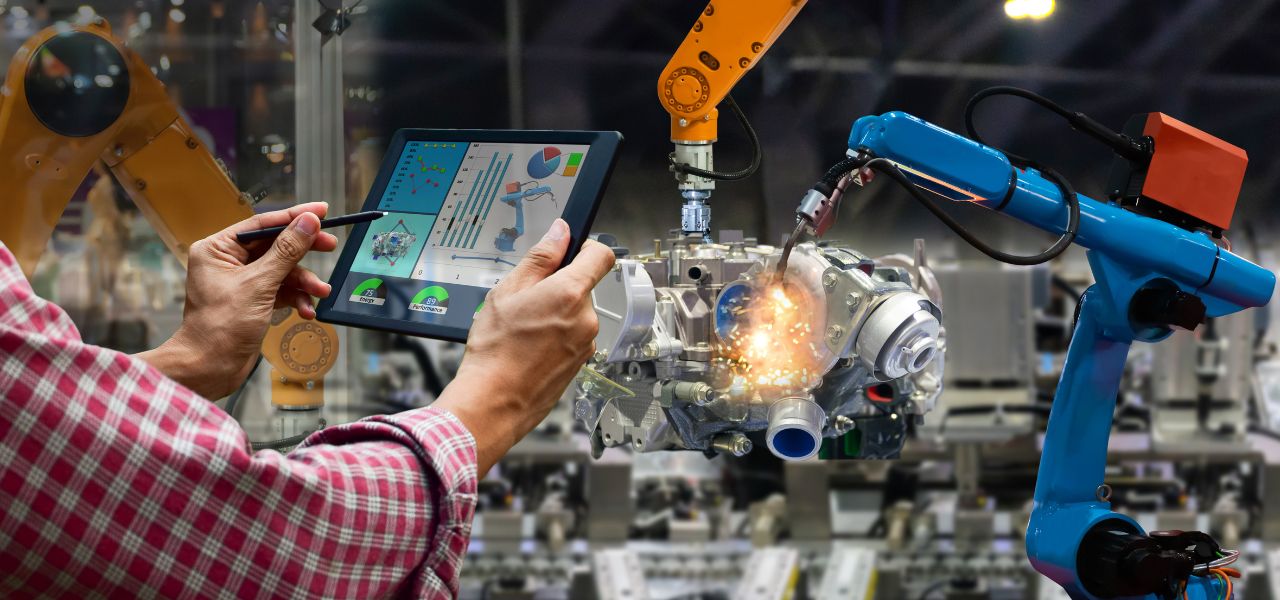
For decades, the metrics that defined manufacturing excellence were physical and financial: Overall Equipment Efficiency (OEE), yield, scrap rate, and cost per unit. Cybersecurity, if considered at all, was an IT concern—a matter of firewalls and passwords for office networks, far removed from the factory floor. This mindset is now a profound and dangerous liability. In the age of connected production, where Industrial IoT (IIoT) sensors, programmable logic controllers (PLCs), and robotics are woven into a single digital fabric, cybersecurity is no longer an IT metric. It is a core manufacturing metric, as critical to your output as spindle speed or thermal tolerance.
For the Chief Operating Officer, Plant Manager, and Head of Production, the threat has moved from the server room to the shop floor. The stakes are no longer just data breaches; they are physical sabotage, theft of proprietary processes, and catastrophic production halts. Your most valuable intellectual property (IP) is no longer just in CAD files or patent documents; it is in the real-time operational data and machine recipes running on your production line. Protecting it is now a direct responsibility of manufacturing leadership.
The New Threat Landscape: The Factory as a Target
Modern smart factories are attractive targets for a new breed of adversaries:
- The Industrial Spy: Aims to exfiltrate the proprietary parameters that make your product superior—the exact temperature curve for a composite cure, the proprietary algorithm for a CNC tool path, or the formulation sequence for a specialty chemical.
- The Saboteur: Seeks to disrupt operations by altering machine settings to cause mass scrap, manipulating robotic coordinates to cause collisions, or locking systems with ransomware specifically designed for industrial control systems (ICS), like LockerGoga or EKANS.
- The Supply Chain Weapon: Uses a compromised machine as a foothold to pivot and attack other links in your supply chain or to implant malware in the physical products you ship.
The attack vectors are the very technologies driving Industry 4.0: wireless sensors, networked PLCs, legacy machines connected via gateways, and remote maintenance portals.
Why Traditional IT Security Fails on the Factory Floor
Applying standard IT security to Operational Technology (OT) is like using a sports car in a quarry—it’s the wrong tool for the environment.
- The Uptime Imperative vs. Patching: You cannot reboot a blast furnace or a continuous process line for a security update during a production run. IT’s “patch Tuesday” is OT’s “potential disaster Wednesday.”
- Legacy Systems: Production lines often run on Windows XP or embedded OSs that are decades old, cannot be patched, and were never designed for network connectivity.
- Protocol Fragility: Industrial protocols (like Modbus, Profinet) are often inherently insecure, lacking authentication and encryption, assuming a physically protected network.
Therefore, cybersecurity must be designed into the manufacturing process itself, measured and managed with the same rigor as quality or efficiency.
The Five Pillars of Cyber-Physical Manufacturing Security
To protect your IP and ensure resilient production, you must build security into these five foundational layers:
Pillar 1: Cyber-Physical Asset Inventory & Segmentation (The “Digital Twin of Security”)
You cannot secure what you cannot see.
- Action: Create a real-time inventory of every connected device on the plant network—not just PCs, but every sensor, drive, robot controller, and camera. Map their communications.
- Manufacturing Metric: Percentage of Production Assets with a Verified Digital Identity. Then, enforce micro-segmentation. The painting robot’s network should not be able to talk to the design server holding CAD files. This contains breaches.
Pillar 2: Secure-by-Design Machine Integration (Shifting Left)
Security must be a requirement for any new machine or sensor brought onto the floor, as non-negotiable as its voltage rating.
- Action: Mandate that all new equipment purchases and IIoT deployments support secure boot, hardware-based trusted platform modules (TPM), and encrypted communications. Work with OEMs and partners like Cionlabs, who engineer this in from the first schematic.
- Manufacturing Metric: 100% Secure Onboarding Compliance for New Assets. Reject equipment that doesn’t meet the standard.
Pillar 3: Anomaly Detection in Operational Data (The “Digital Ear”)
Your IIoT data stream is your best detective. Unusual patterns can indicate a cyber-physical attack in progress.
- Action: Deploy AI-driven anomaly detection not just for predictive maintenance, but for cyber-physical threat detection. Is a motor drawing power at 2 AM when the line is idle? Are network packets flowing from a PLC to an unknown external IP? Is a valve being commanded to open outside a valid parameter range?
- Manufacturing Metric: Mean Time to Detect (MTTD) Anomalous Operational Behavior. This should be measured in minutes, not days.
Pillar 4: Integrity Verification for Critical Processes (The “Digital Seal”)
How do you know the recipe running on the machine hasn’t been tampered with?
- Action: Implement cryptographic integrity checks for critical machine programs and recipes. Use digital signatures. Before a CNC machine executes a toolpath, its controller verifies the program’s signature. Any unauthorized change halts execution.
- Manufacturing Metric: Number of Unverified Program Execution Attempts Blocked. This is a direct measure of IP protection efficacy.
Pillar 5: Resilient Recovery & Continuity (The “Cyber-Physical SOP”)
Assume a breach will occur. Your response must be a rehearsed manufacturing procedure, not an IT panic.
- Action: Develop and drill cyber-physical incident response playbooks integrated with standard operating procedures (SOPs). If a welding cell is compromised, what is the safe manual override process? How do you isolate it and switch to a backup cell while preserving forensic data?
- Manufacturing Metric: Recovery Time Objective (RTO) for Critical Production Cells. Test this like you test a fire drill.
The Leadership Mandate: Forging the OT-IT-Security Alliance
This cannot be led by IT alone. It requires a new, fused leadership model.
- Appoint a Cyber-Physical Security Lead: This role must report to the COO or Plant Head, not just the CIO. They must speak the language of both PLCs and firewalls.
- Integrate Security into Production Meetings: Cyber risk metrics should be reviewed alongside OEE and safety reports. “We had three unauthorized access attempts on the SMT line this week” is a production issue.
- Audit Your Supply Chain’s Security: The security of your production network is only as strong as the weakest link in your supply chain. Do your machine tool vendors require secure remote access? Do your component suppliers have secure development practices? Demand evidence.
- Invest in Upskilling Your Workforce: The plant engineer and the maintenance technician are your first line of defense. Train them to recognize cyber-physical threats—a strange USB drive left near a machine, an unfamiliar technician requesting network access.
The Cionlabs Imperative: Engineering Security into the Machine’s DNA
We operate at the nexus of hardware and security. For us, building secure manufacturing assets is not an add-on; it is the first principle of design.
- Hardware-Rooted Trust: We design with secure elements and cryptographic processors that provide an unforgeable identity for every device, forming the foundation of your asset inventory and integrity checks.
- Secure Connectivity Architecture: We implement zero-trust principles at the hardware level, ensuring sensors and machines communicate only with authorized partners over encrypted channels.
- Lifecycle Security Management: We build in secure, over-the-air (OTA) update capabilities with rollback protection, allowing you to patch vulnerabilities without stopping the line, turning the “uptime vs. security” dilemma into a solved problem.
Conclusion: The New Measure of Manufacturing Excellence
In the connected factory, a hacker can inflict more financial damage in minutes than a mechanical failure could in days. Therefore, downtime prevented by cybersecurity is as valuable as downtime prevented by predictive maintenance.
Cybersecurity must be elevated from a technical compliance checklist to a strategic manufacturing competency. It is a direct enabler of operational resilience, IP protection, and brand integrity. The factories that will lead will be those that measure and manage their cyber-physical health with the same precision they apply to dimensional tolerances.
When you walk the factory floor of the future, the hum of machines will be accompanied by the silent, vigilant hum of a secure, resilient, and intelligent production ecosystem. Building that future starts not with a software update, but with a fundamental shift in mindset: Cybersecurity is a manufacturing metric. Protect your line like you protect your product.
Ready to build cybersecurity into the foundation of your connected production?
Contact Cionlabs to design and integrate industrial hardware and IoT systems with security engineered from the silicon up, turning your smart factory into a resilient fortress.